
Fall sealcoating in Colorado Springs comes with a deadline most property owners find out about too late. Every year we get the same call in the third week of October — someone finally decided to seal, the weather looks fine, it’s 62 degrees and sunny — and we have to tell them no. Not because we don’t want the work. Because the sealer won’t cure, and putting it down anyway would waste their money.
Here’s the part most Colorado Springs property owners don’t know: the fall sealcoating deadline isn’t a date on the calendar. It’s a temperature. And at 6,035 feet, that temperature arrives a lot earlier than people expect.
If you’ve been putting off sealcoating your driveway, parking lot, or HOA roadway this year, this post explains exactly how much time you actually have left — and what happens to your asphalt if you decide to wait until spring instead.
Why Fall Sealcoating in Colorado Springs Has a Hard Cutoff
Sealer isn’t paint. It’s an emulsion — asphalt or coal tar suspended in water. When it goes down, the water has to evaporate out of it so the remaining material can coalesce into a continuous, bonded film across your pavement. That process is called curing, and it’s driven almost entirely by temperature and humidity.
Manufacturer specifications are consistent on this point. Sealer needs to be applied when the surface and air temperature are at least 50°F and rising, with no risk of dropping below 50°F for the following 24 hours. SealMaster’s application guidelines hold that line for exactly this reason.
Notice the two conditions there. Not just “50 degrees.” Fifty degrees and rising, and staying above 50 overnight. That second condition is what kills fall sealcoating in Colorado long before the daytime highs look like a problem.
What Actually Happens in Colorado Springs
Our elevation and dry air mean we lose heat fast after sundown. A 70-degree afternoon here can drop into the high 30s overnight in late September. That daytime number looks fine. The overnight number is what ruins the cure.
Sun Angle Shortens the Fall Sealcoating Colorado Springs Window
There’s a second factor nobody talks about. By late September, the sun sits lower and the pavement gets fewer usable hours of direct heat. A north-facing driveway or a lot shaded by a building on the south side can stay 10 to 15 degrees colder than the ambient air reading all day long.
We’ve measured surface temps on shaded sections of commercial lots in early October that were still in the 40s at 2 p.m. while the thermometer read 61. That section will not cure. And a partially cured sealcoat isn’t half-protected — it’s a soft, tacky film that tracks onto tires, scuffs under traffic, and peels off through the first freeze.
What Happens If You Skip This Fall and Wait Until Spring
This is the real cost, and it’s the part that gets underestimated. Sealcoating isn’t cosmetic. It’s a moisture barrier. Skipping a season doesn’t mean your pavement stays exactly the same until April — it means your pavement goes into a Colorado winter with its surface unprotected.
Here’s what a winter does to unsealed asphalt in our climate:
- Water gets into the surface. Oxidized, unsealed asphalt is porous. Snowmelt soaks in instead of running off.
- That water freezes and expands roughly 9%. Every hairline crack gets pried a little wider from the inside.
- We thaw and refreeze constantly. Colorado Springs runs well over a hundred freeze-thaw cycles a season. It’s not one hard freeze — it’s the same crack being levered open and released, over and over, for four months.
- De-icing chemicals attack the binder. Magnesium chloride and salt break down the asphalt binder holding your aggregate together.
- Spring reveals the damage. Cracks that were hairline in October are quarter-inch in April. Some are potholes.
The math is straightforward. Sealcoating is a maintenance expense. Crack repair is a bigger one. Pothole patching is bigger than that. Resurfacing is a capital expense, and full replacement is the one that blows up an HOA budget or a property maintenance line item.
Every winter you skip pushes your pavement one step further down that list. And once base damage starts, sealcoating can’t fix it — you’re past the point where the cheap solution works.
Seal Now or Repair First? How to Tell
One important caveat: if your pavement already has significant cracking, sealcoating alone isn’t the answer this fall. Sealer bridges hairline surface cracks. It does not fill structural cracks, and applying it over an open crack just puts a thin skin over a hole that water is still going to get into.
Use this as a rough field test:
- Cracks narrower than a pencil, surface looks gray and faded: sealcoating is the right call. Get it done now.
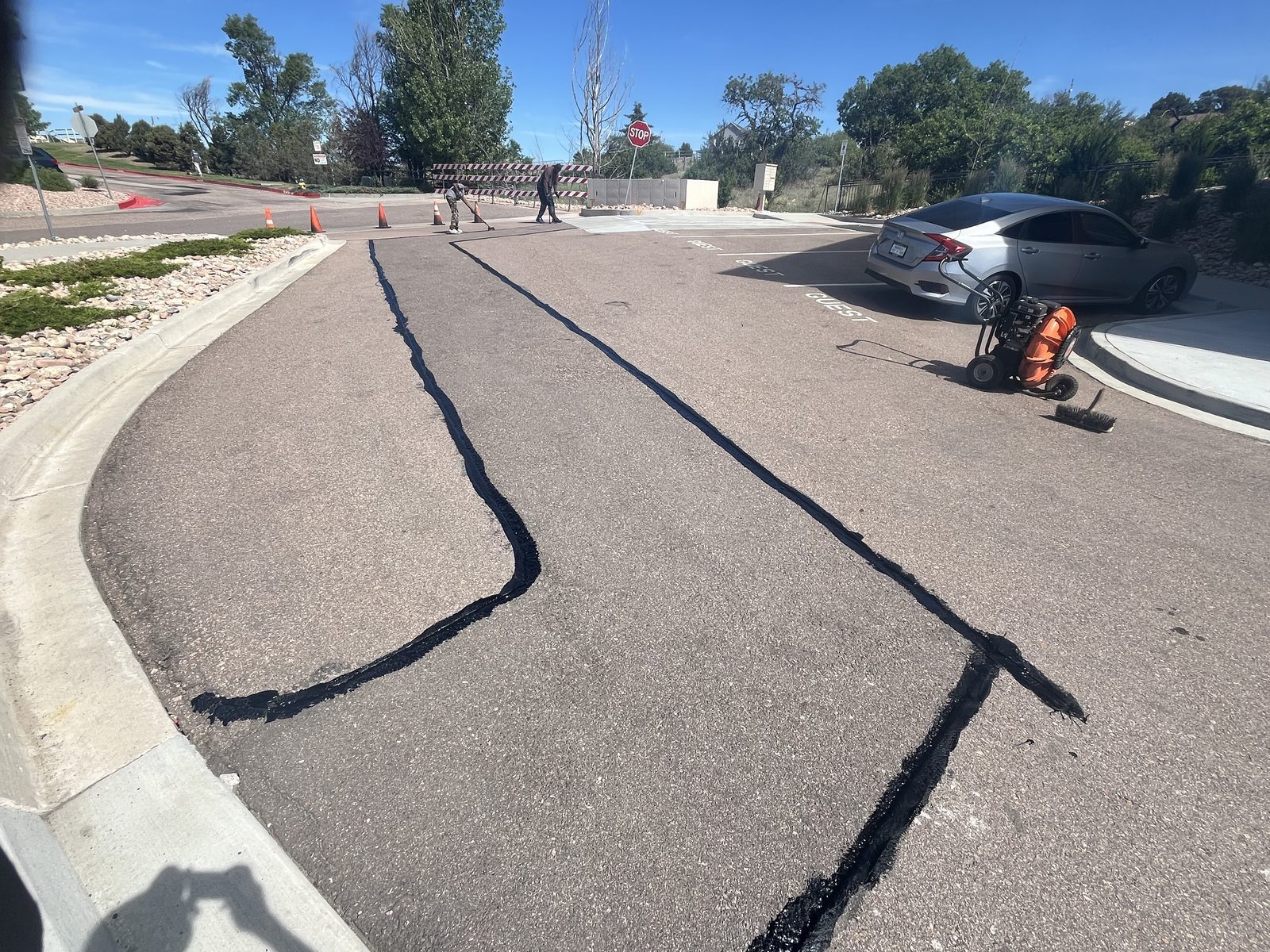
- Cracks wider than a quarter inch, or long joints running through the lot: you need hot-applied crack repair first, then seal over it. Both can usually happen in the same visit.
- Alligator cracking, soft spots, or areas that flex under a vehicle: that’s base failure. Sealcoating won’t help. You’re looking at resurfacing or full-depth repair, and we’d tell you that straight rather than sell you a sealcoat that won’t hold.
We’d rather tell you your lot needs something other than what you called about than take money for a service that won’t solve your problem. That judgment call is most of what fall sealcoating in Colorado Springs actually comes down to — right service, right surface, right window.
Commercial Lots and HOAs: Fall Sealcoating in Colorado Springs Books Out Earlier
If you manage a commercial property, retail center, apartment complex, church, or HOA community, back your planning window up further. Two reasons.
First, scale. A large lot can’t be sealed and cured in a single afternoon window. We phase the work — seal a section, let it cure, open it, move to the next. That means you need multiple consecutive days of good conditions, not one. In September, that’s a real constraint.
Second, approvals. HOA boards meet monthly. Property management companies need bids, purchase orders, and sometimes owner sign-off. If your board meets in early September and you’re bringing the proposal to that meeting, the work realistically lands in late September at the earliest — right at the edge of the window.
If you’re at that stage now, get the estimate in hand this month so the number is ready when the board sits down. We cover the scheduling and phasing side in more detail on our commercial sealcoating page.
What We Do Differently on Late-Season Jobs
When we’re working the back half of the season, the process changes. This isn’t the same job we do in June.
- We check surface temperature, not air temperature. Infrared gun on the actual pavement, in the shaded sections, before we commit to the day.
- We start early and finish early. Application goes down in the morning so the sealer gets the full afternoon of direct sun to cure before temps fall.
- We watch the overnight forecast, not the daytime high. If it’s dropping below 50 tonight, we don’t seal today.
- We’ll reschedule you rather than force it. If the weather turns, we move the date. A job done wrong in October is a job we’re redoing in May at our own cost — and neither of us wants that.
That last one matters. If a contractor is willing to lay sealer on your pavement in mid-November because you asked them to, that tells you what you need to know about how they’ll handle the rest of the job.
15% off all services when you book before September 30. That deadline isn’t a marketing gimmick — it’s the same deadline the weather gives us. Booking before the end of September is what guarantees your job lands inside a real cure window instead of a hopeful one.
Fall Sealcoating Colorado Springs: The Short Version
August is your best remaining month. September works if you book it now and we schedule mornings. October is a gamble that some years pays off and some years doesn’t. After that, you’re waiting until spring — and spending the winter watching water do to your asphalt what water does.
If you’re not sure whether your pavement needs sealcoating, crack repair, or something more, we’ll come look at it and tell you straight. Free estimate, no pressure, and an honest answer even when the honest answer is “this can wait until spring.”
Get Your Free Estimate Before the Window Closes
Serving Colorado Springs, Fountain, Monument, Falcon, Peyton, Black Forest, Security-Widefield, Woodland Park, and Pueblo. Registered as a Colorado LLC and Insured, and owner-operated since 2017.
Clear Choice Paving & Koncrete — Built for Colorado. Built to Last. Learn more about our sealcoating services in Colorado Springs.